
What is justice, and how is it used within human civilization and society? If we slow down and really think about it, are we applying justice as it was intended, or has it become something else entirely? Has justice evolved into a tool for understanding and balance, or has it been reshaped into a mechanism for control, punishment, and division?
Dictionary Meaning
The following is a definition of just behavior according to the Oxford reference.
Just behavior or treatment. “a concern for justice, peace, and genuine respect for people”
At first glance, this definition seems simple and reasonable. Justice is associated with peace, respect, and fair treatment. Yet when we compare this definition to how justice is often applied in the real world, a clear disconnect appears.
Justice According to the New York Bar Association
Here is a more in depth reference from the New York Bar Association, which explores the difference between equality and justice and how justice is interpreted within legal systems.
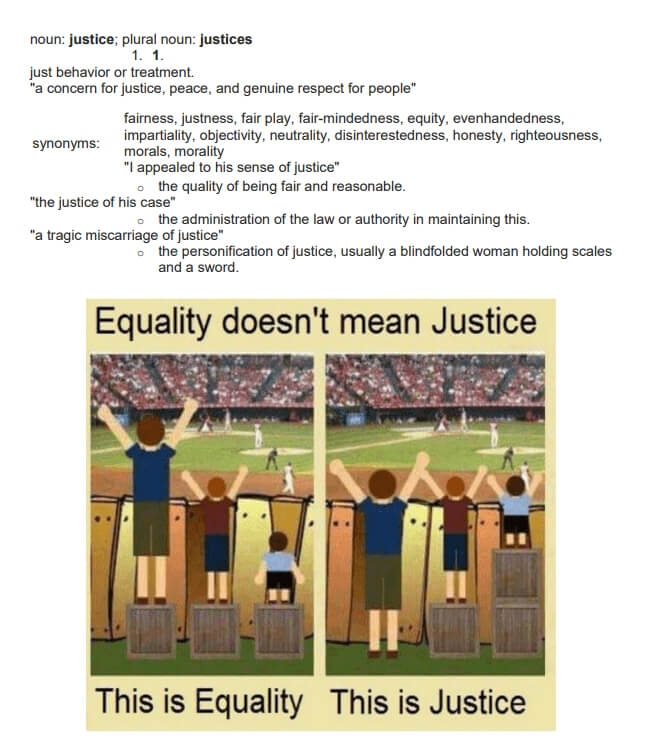
How Justice Is Misused in the World
Instead of seeking to genuinely understand, and when necessary, correct or guide out of concern and respect, justice is often used as a tool to judge, isolate, condemn, and punish. It is frequently applied to those who have already been separated by social conditioning, cultural differences, or circumstance.
When justice is reduced to judgment, its original purpose is lost. Rather than creating peace, it reinforces division. Rather than fostering understanding, it amplifies resentment.
It is no surprise that this misuse results in a world filled with indifference, a lack of empathy, hatred, war, and destruction. We often find ourselves governed and guided by systems that reflect unresolved fear and separation, rather than wisdom or compassion.
What Appears to Happen with the Misuse of Justice?
When judgment is placed, the accuser unknowingly assumes ownership of the problem. Much like a magnet attracting its opposite pole, the issue becomes something the accuser can no longer stop seeing. The perceived enemy or wrongdoing begins to appear everywhere.
At the same time, this mindset spreads easily. Judgment behaves like a contagion. It moves from person to person, system to system, reinforcing the belief that punishment is the solution rather than understanding.
In this way, justice becomes less about balance and more about eradication. The focus shifts from healing to elimination, from resolution to dominance.
True Just Behavior and Treatment
A real solution may be found by creating environments that condition us to be curious rather than judgmental. Environments that encourage understanding first, and restraint in condemnation.
Justice, in its truest form, may begin with humility. Recognizing that each of us is a very small, yet essential, part of a much larger whole. Both insignificant on our own, and absolutely necessary together.
Such an environment would bring out a person’s strengths and abilities, guiding them through collaboration rather than coercion. Direction would come from shared insight rather than imposed authority.
In this space, there would be no need to fixate on weakness or disability. Instead, there would be peer support through open communication, genuine curiosity, and wisdom shared through experience. The goal would not be punishment, but integration.
An effort for each individual to find acceptance as a meaningful part of the same whole.
That is what I call real justice.